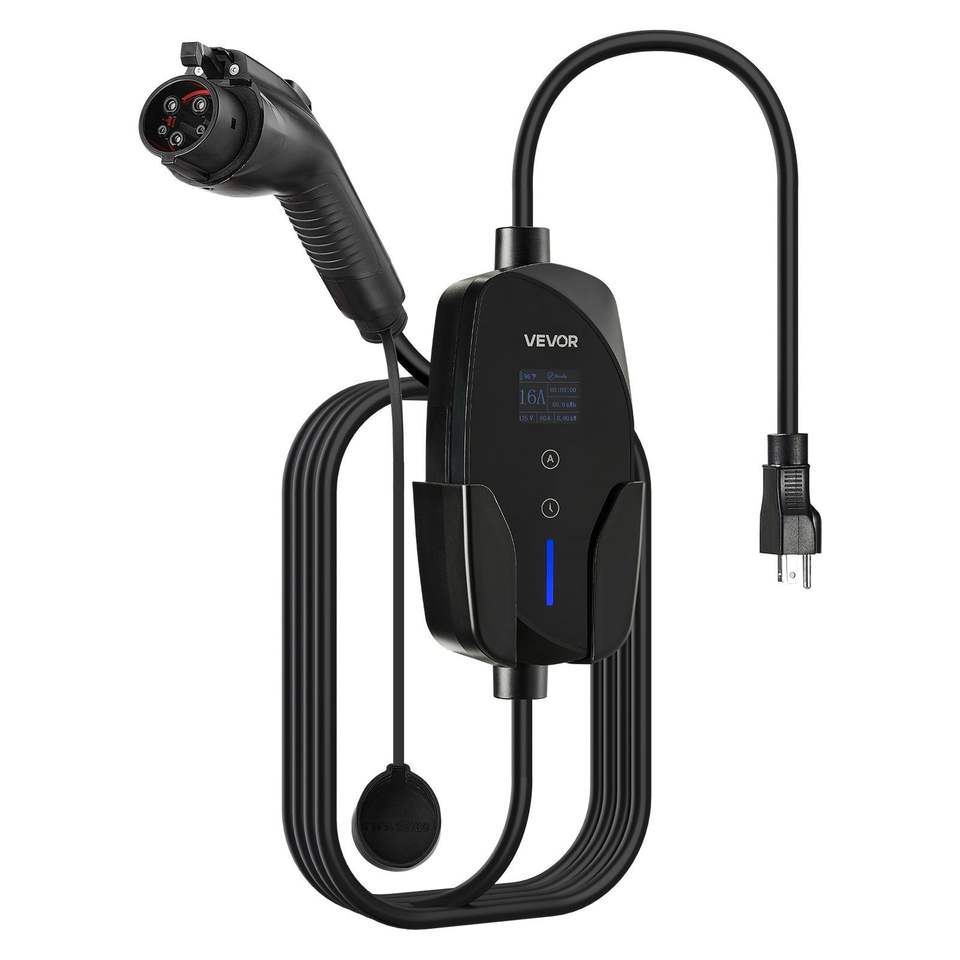
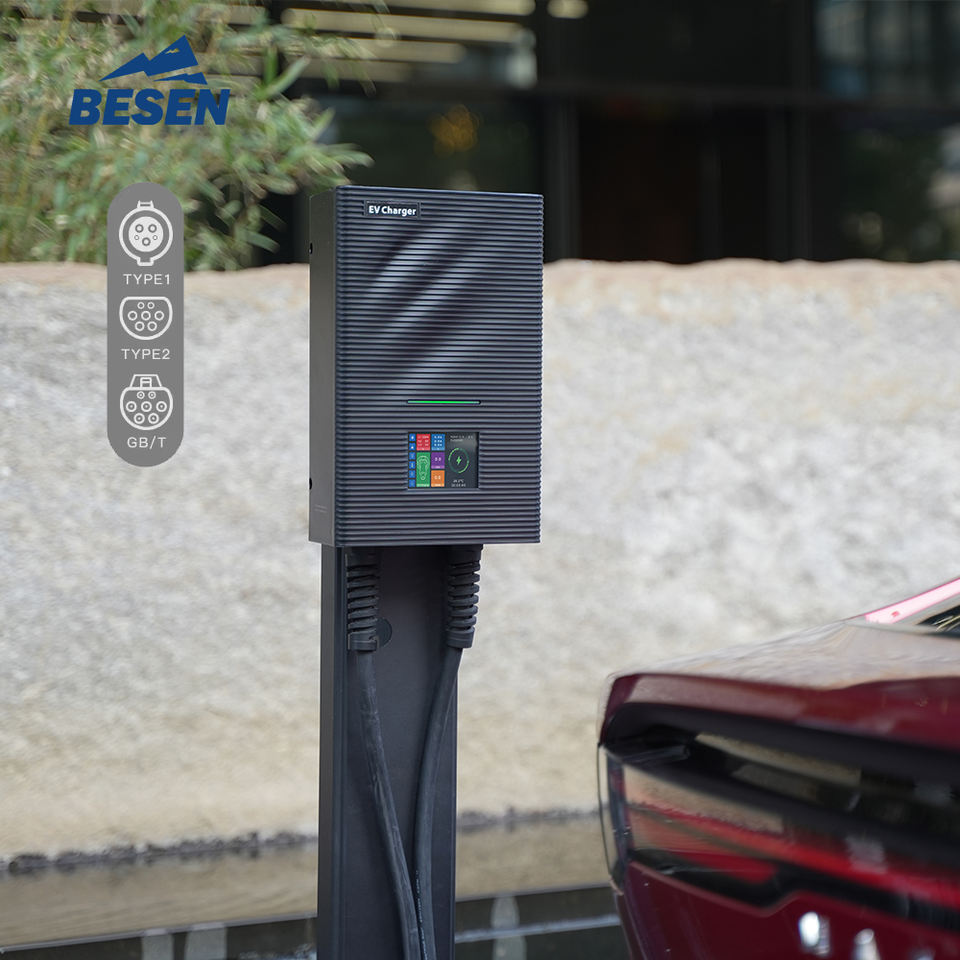
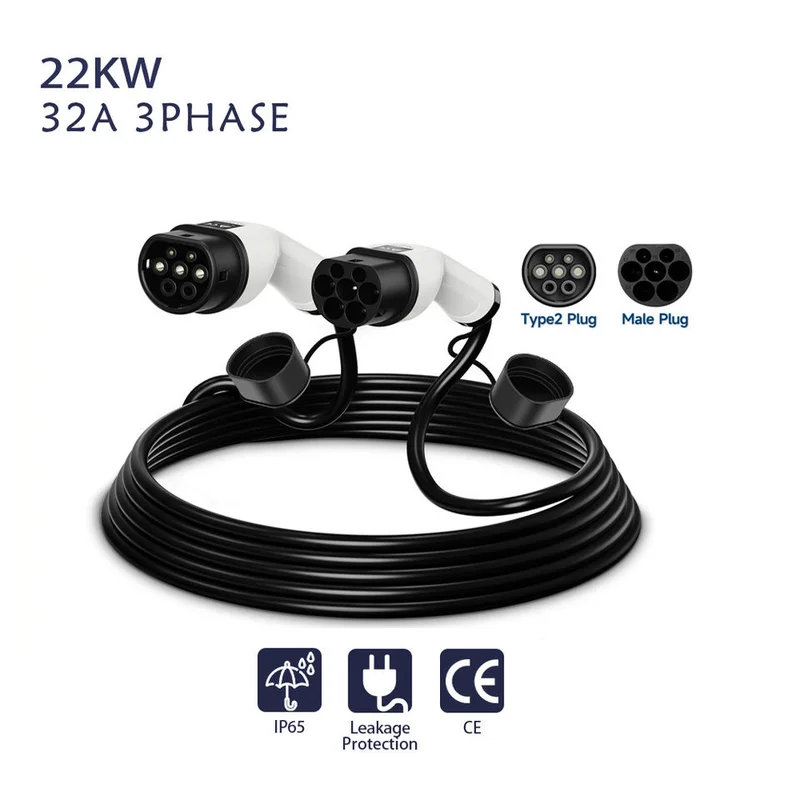
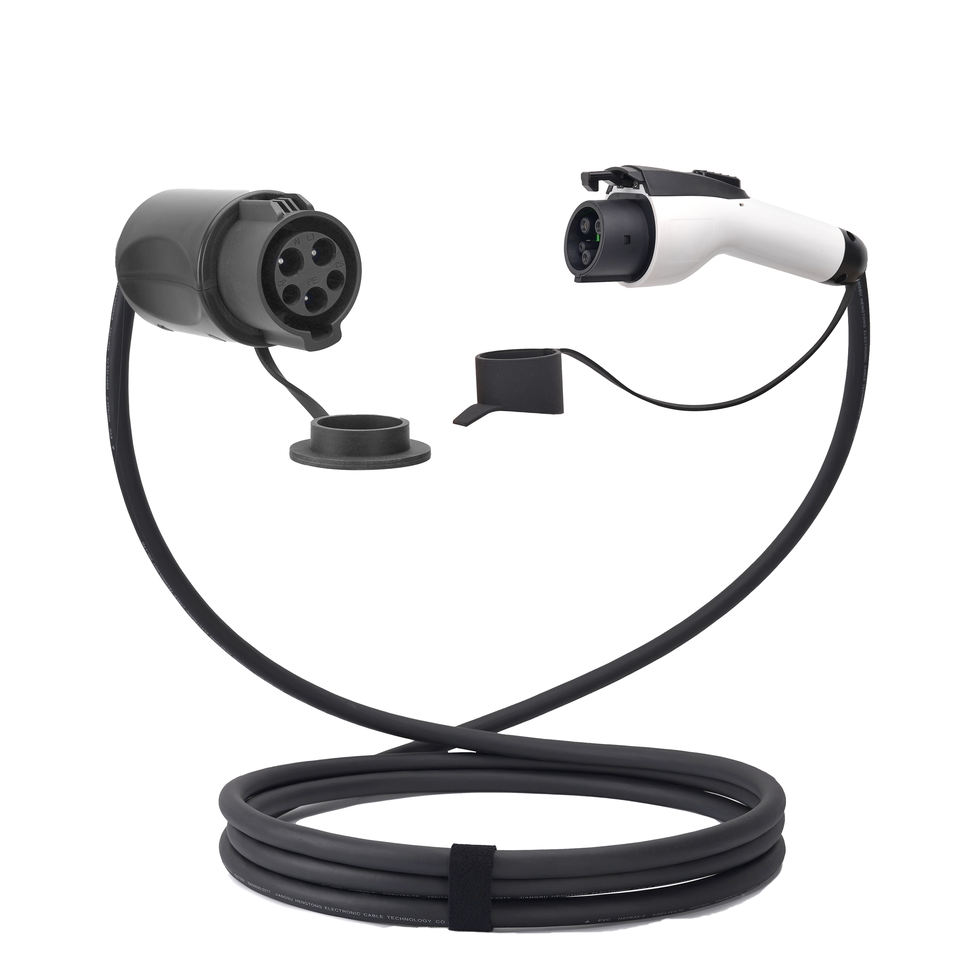
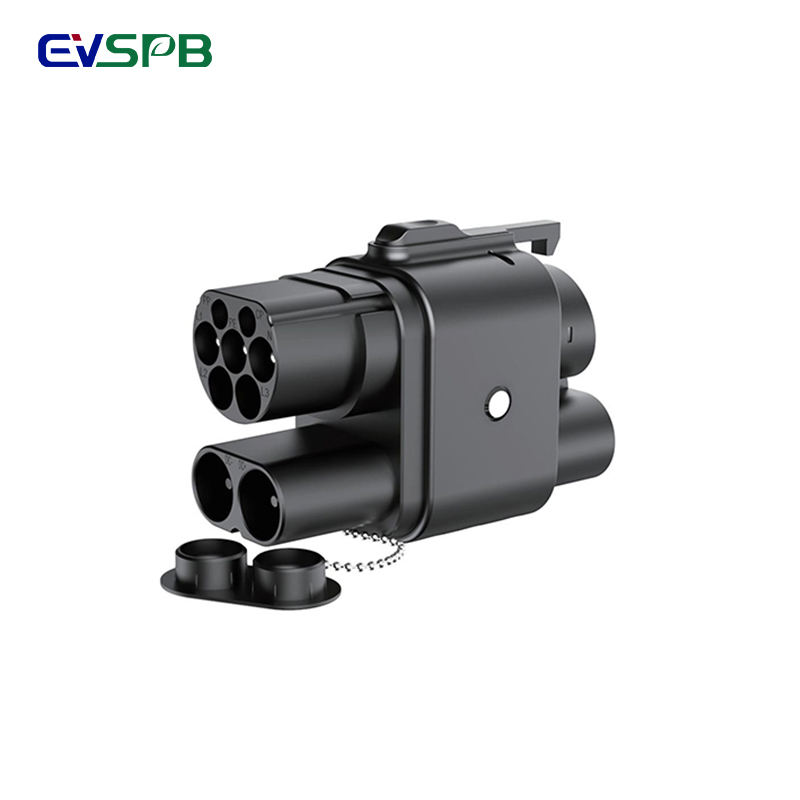
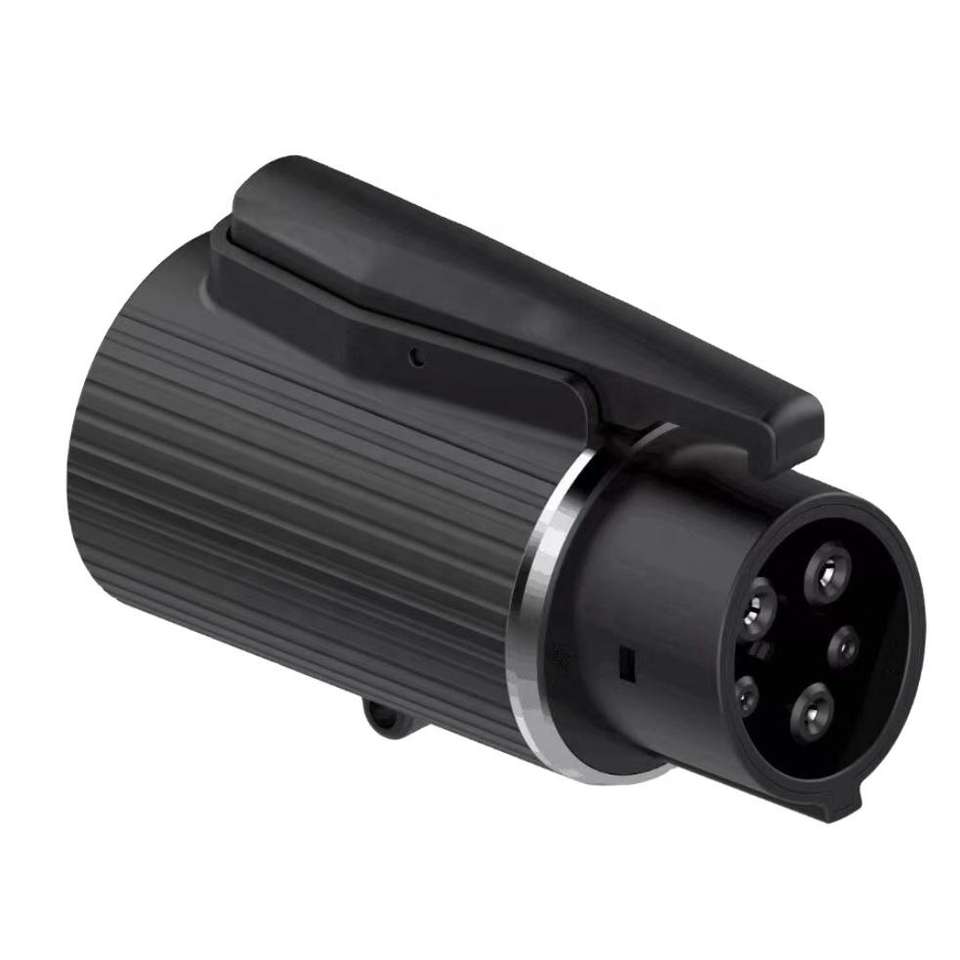


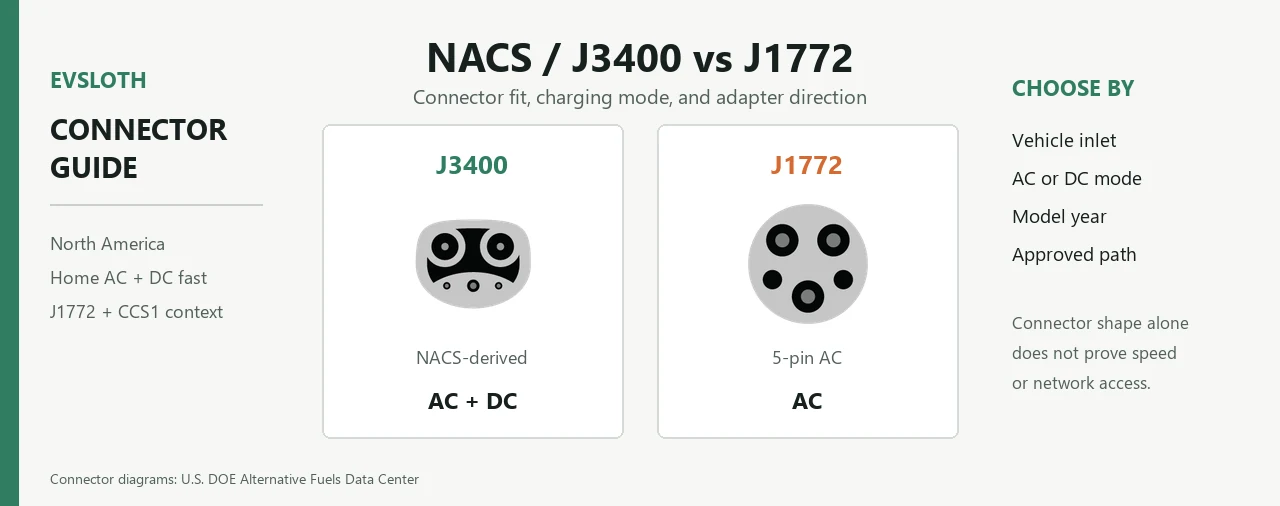
In the NACS vs J1772 comparison, NACS is standardized by SAE as J3400 and carries AC and DC charging through one connector design. J1772 is the five-pin North American AC connector; CCS1 adds two DC contacts below it for fast charging. Choose by your vehicle inlet, charging mode, model year, and manufacturer-approved adapter path. The connector name alone does not determine charging speed or network access.
Scope and review date: This guide covers passenger-EV charging in the United States and Canada and was source-checked on September 5, 2026. Vehicle support, firmware, adapter approval, and charging-network access can change. Confirm the current instructions for your exact vehicle and charger before buying or connecting an adapter.
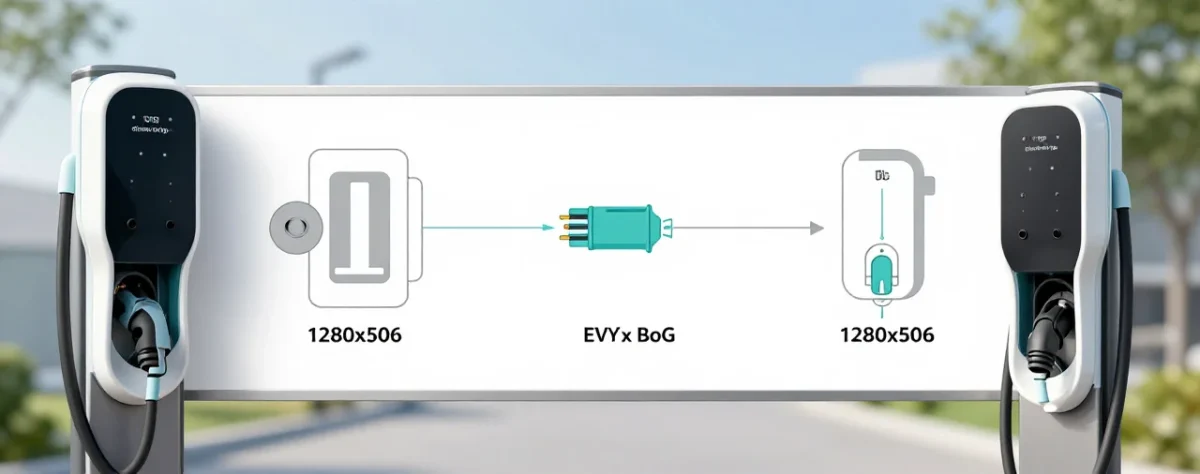
Featured image: J3400 and J1772 connector diagrams from the U.S. Department of Energy Alternative Fuels Data Center; labels and layout by EVSloth.
NACS vs J1772 at a glance
| Question | NACS / SAE J3400 | SAE J1772 |
|---|---|---|
| What is it? | A connector system based on Tesla’s North American Charging Standard design. SAE standardized it as J3400. | A five-contact SAE coupler used for AC Level 1 and Level 2 charging in North America. |
| AC charging. | Supported through the J3400 connector. | Supported through the J1772 connector. |
| DC fast charging. | Supported through the same J3400 connector body. | Not through J1772 alone. CCS1 adds two large DC contacts below the J1772 section. |
| Does the connector set charging speed? | No. The vehicle, EVSE or fast charger, circuit, battery, temperature, and software also impose limits. | No. The same system-level limits apply. |
| Can an adapter bridge them? | Sometimes. The direction, AC/DC mode, vehicle, charger, ratings, and approvals must all match. | Sometimes, under the same conditions. |
| Best home-charging choice. | Prefer the cable that natively matches the vehicle you charge most often. Use only a documented adapter path when needed. | |
The short version is that NACS vs J1772 is not a winner-takes-all speed contest. It is a compatibility decision. Native fit is usually the simplest home setup, while adapters can preserve access during the long transition between vehicle and station hardware.
What do NACS, J3400, J1772, and CCS1 mean?
Are NACS and SAE J3400 the same thing?
They refer to closely connected versions of the same connector lineage. Tesla published its connector design under the North American Charging Standard name. SAE International then developed the open J3400 standard from that design. The Joint Office of Energy and Transportation says SAE published a J3400 Technical Information Report in December 2023. Its EV Coupler Task Force voted in August 2024 to establish J3400 as a Recommended Practice. SAE approved J3400_202409 on September 30, 2024. For a current purchase, check the precise standard, certification, electrical rating, and vehicle support. Do not rely only on a product using the word “NACS.”
Is J1772 the same as CCS1?
No. J1772 is the familiar round, five-contact AC interface. CCS1, also called the SAE J1772 Combo connector, retains that upper AC interface and adds two large DC contacts below it. A vehicle with a CCS1 inlet can accept a J1772 plug for AC charging, while a CCS1 DC fast-charging plug uses the complete combo inlet. This distinction matters because a small AC adapter is not a substitute for a DC fast-charging adapter.
For a broader visual overview, see EVSloth’s guide to DC fast-charging connector types and global EV plug standards overview.
Which connector is better for home charging?
The better home connector is normally the one that fits your vehicle without an adapter. If your vehicle has a J3400 inlet, a native J3400 home charging cable removes one connection point. If it has a J1772 or CCS1 inlet, a native J1772 home cable does the same for AC charging. A household with both inlet types can choose the connector used by the primary vehicle. It can keep an approved AC adapter for the second vehicle.
Do not choose solely from an advertised maximum. The DOE’s charging infrastructure guide names several factors that change charging time. They include battery state of charge and capacity, battery type, the vehicle’s internal charger, charger output, and electrical service. During AC charging, the vehicle’s onboard charger converts AC power for the battery. A connector capable of more current cannot force a car, circuit, or EVSE to accept or deliver more.
A practical home-charger decision sequence
- Read the vehicle manual. Confirm the physical inlet, model year, sales region, maximum AC input, and approved adapters.
- Separate AC from DC. Home Level 1 and Level 2 equipment normally supplies AC. Supercharger or other corridor fast-charging access is a separate DC decision.
- Check the electrical installation. Match EVSE current to the dedicated circuit, continuous-load requirements, service capacity, local code, and manufacturer instructions.
- Prefer native fit. Fewer interfaces make daily handling simpler. They also remove one compatibility check.
- Document any adapter path. Write it as charger connector to adapter to vehicle inlet. Then verify that exact direction and charging mode.
- Plan for the cars you actually own. Do not create a poor fit for today’s vehicle based only on a future transition. An approved replacement cable or adapter may address a later change.
If you are also sizing the EVSE and circuit, use the home EV-charger amperage guide and the home EV-charger selection checklist. Connector fit is only one line in the specification.
Does NACS charge faster than J1772?
Not by name alone. A fair comparison must hold the charging mode, supply, vehicle, and conditions constant. For AC charging, power is limited by the available circuit, EVSE setting, and vehicle onboard charger. During DC fast charging, the station and vehicle both impose limits. Battery voltage, state of charge, temperature, charge curve, cable or adapter temperature, and network controls can all change delivered power.
J3400 can carry both AC and DC through one compact connector design. J1772 handles AC, while the related CCS1 inlet adds separate DC contacts. That architectural difference does not mean every J3400 session is faster than every J1772 or CCS1 session. A 7.2 kW J3400 home session and a 7.2 kW J1772 home session deliver the same nominal power before losses. Likewise, a vehicle’s peak DC number does not predict its full charging curve.
EVSloth’s EV charging-speed explainer covers the other limits that belong in a charging-time comparison.
How do NACS and J1772 adapters work?
An adapter changes the physical interface and may route the required power and signaling contacts. It does not automatically create vehicle support, network permission, or a new charging mode. The Joint Office adapter-compatibility guidance says not every adapter works with every vehicle or charger. It advises drivers to use products supplied for the specific vehicle and to follow their instructions.
The current UL 2252 Edition 1 scope makes the mode boundary explicit. The standard was published March 19, 2025 and revised June 24, 2026. It covers adapters that change the physical interface while maintaining charging communication; they do not convert AC voltage to DC or DC to AC. UL also states that covered devices may be used for AC or DC, but not both. Treat any product that claims one passive adapter handles both modes as a stop-and-verify signal.
| Intended session | Write the direction this way | What to verify |
|---|---|---|
| J1772 AC charger to J3400 vehicle. | J1772 charger plug -> approved AC adapter -> J3400 vehicle inlet. | Vehicle support, AC-only use, continuous current, latch, temperature limits, and instructions. |
| J3400 AC charger to J1772/CCS1 vehicle. | J3400 AC plug -> approved AC adapter -> J1772 interface (the upper five-contact section on a CCS1 inlet). | AC compatibility, direction, ratings, vehicle support, and charger restrictions. |
| J3400 DC fast charger to CCS1 vehicle. | J3400 DC plug -> automaker-approved DC adapter -> CCS1 vehicle inlet. | Exact model and model year, software, network eligibility, charger generation, DC voltage/current, thermal limits, and adapter approval. |
These products are not interchangeable just because each description includes “NACS,” “J1772,” or “CCS.” Confirm the connector at the charger end and the inlet at the vehicle end. Then confirm whether the session is AC or DC. Never stack adapters unless every involved manufacturer explicitly documents that setup. For more detail, read the EV adapter safety and certification guide and adapter locking-mechanism guide.
Can every J3400 vehicle use every Supercharger?
No. A matching connector is necessary but may not be sufficient. Access can depend on the automaker’s agreement and the vehicle’s hardware or software. The station generation, country, account workflow, and need for an approved DC adapter can also matter. Check the vehicle manufacturer’s current charging-support page and the network’s live station listing before a trip. A map pin labeled “NACS” does not prove that a particular vehicle can start a session there.
The reverse is also true: fitting a J1772-to-J3400 AC adapter does not turn a J1772 destination charger into a DC fast charger. Charging mode comes from the equipment and vehicle architecture, not the shape-changing part between them.
Will J1772 become obsolete?
J3400 adoption is changing new-vehicle and charging-equipment choices, but J1772 equipment and J1772/CCS1 vehicles do not vanish when a newer model adopts another inlet. Existing homes, workplaces, hotels, parking facilities, and public charging sites represent a large installed base. During the transition, native cables, approved adapters, and dual-connector sites can all have valid roles.
A sensible purchase should account for expected service life without treating an industry roadmap as a guarantee. Check whether a home EVSE offers a replaceable cable. Also check whether its manufacturer documents an adapter and covers that use under warranty. For many owners, the practical NACS vs J1772 choice is not a forced replacement. A safe, correctly installed J1772 EVSE may still serve a future J3400 vehicle through an approved AC adapter.
Adapter and connector safety checklist
- Use an adapter explicitly approved for the vehicle, charger connector, direction, and AC or DC mode.
- Verify voltage, continuous current, environmental rating, operating temperature, and applicable independent safety certification.
- Inspect housings, contacts, seals, cable strain relief, latch, and lock before connecting.
- Keep contacts clean and dry. Never force a connector that will not seat normally.
- Support heavy DC cables. Do not let them twist or lever against the vehicle inlet.
- Stop charging for smoke, arcing, melting, burning odor, abnormal heat, a failed latch, repeated faults, or water intrusion.
- Follow the documented shutdown sequence before disconnecting. Quarantine damaged equipment.
SAE standards define system requirements. UL 2251 covers plugs, receptacles, and couplers for electric vehicles, while the active UL 2252 standard covers EV charging adapters. A marketplace listing saying “compatible” is not equivalent to an applicable certification or written vehicle approval. EVSloth’s editorial policy explains how this site separates standards evidence, manufacturer instructions, and merchant claims.
Frequently asked questions
Can a J1772 charger charge a vehicle with a NACS or J3400 inlet?
Often, but only through a compatible AC adapter approved for that vehicle and direction. Check the vehicle manual, adapter current rating, latch and temperature instructions, and EVSE restrictions. This is an AC charging path; it does not provide DC fast charging.
Can a NACS home charger charge a J1772 vehicle?
It may when a manufacturer-approved J3400-to-J1772 AC adapter supports the exact vehicle and charger. Confirm that the product is for AC use and for that direction. Do not substitute a J3400-to-CCS1 DC adapter.
Do I need CCS1 if my vehicle has J1772?
A vehicle needs a CCS1 combo inlet, not J1772 alone, to use CCS1 DC fast charging. The CCS1 inlet includes the J1772 AC section plus two DC contacts. Some plug-in vehicles support only AC charging, so verify the actual inlet and manual.
Which is more future-proof, NACS/J3400 or J1772?
J3400 has broad new-vehicle adoption momentum in North America, while J1772 has a substantial installed AC-charging base. The most practical setup is the one that safely serves your current vehicle and offers a documented path for likely future vehicles. Serviceable cables and approved adapters can matter more than choosing a label.
What should I check before buying an adapter?
Confirm the charger connector, vehicle inlet, charging mode, and adapter direction. Check the vehicle model and year, software needs, electrical ratings, temperature and weather limits, safety certification, network permission, and warranty terms. If any link in that chain is undocumented, do not assume physical fit proves safe operation.
Sources, methodology, and disclosure
This comparison prioritizes primary standards and government guidance. We used the Joint Office pages for SAE J3400 and connector and adapter compatibility, plus the DOE AFDC charging stations guide. We also checked the SAE records for J3400_202409 and J1772_202401, plus the current UL 2252 scope linked above. Source review was completed September 5, 2026. We do not treat a standard’s envelope as a promised vehicle charge rate or infer network access from connector shape.
Commercial disclosure: EVSloth sells EV charging equipment and accessories. This guide is educational and does not certify any product or replace the vehicle, EVSE, adapter, electrical-code, or charging-network instructions. No product is recommended here because the catalog’s individual compatibility and certification claims were not independently verified for this comparison.